
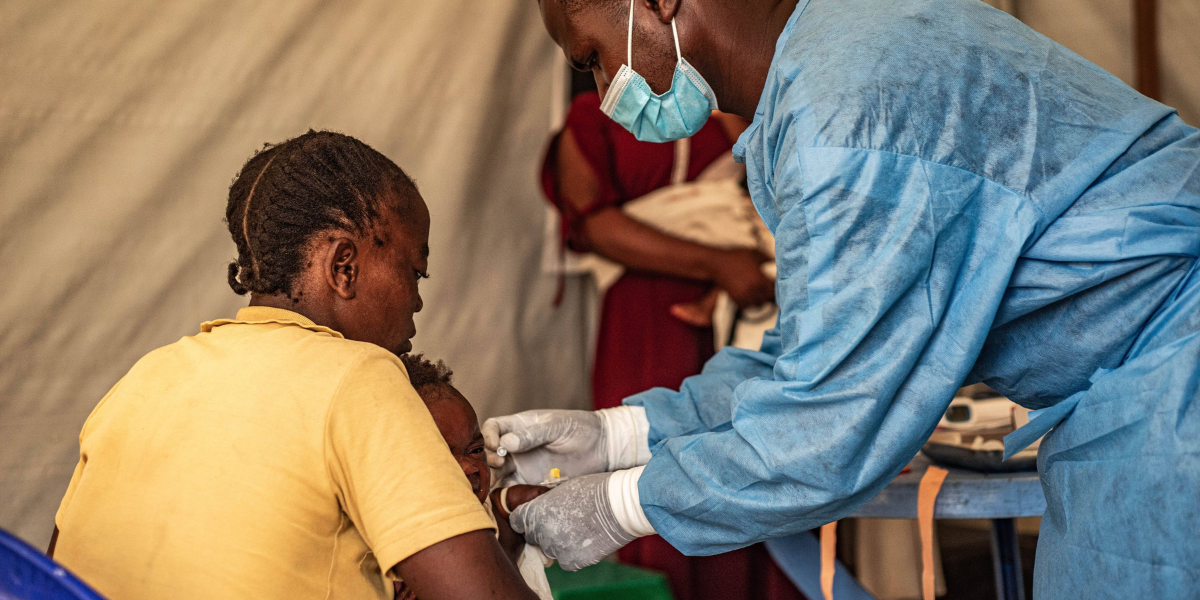
Imagine a village where the nearest clinic is a two-hour walk away. Where "going to the doctor" is not a routine errand but a full-day commitment most families cannot afford — not because of money alone, but because of time, because of distance, because of everything else that stops when a parent has to leave.
Now imagine that one morning, without anyone having to walk anywhere, care arrives. A tent goes up. A table is set. A nurse sits down, and a line begins to form.
That is what a medical camp looks like. And what happens after that line disperses — the weeks and months that follow a single day of outreach is what this story is about.
One Village. One Day. One Tent.
Last year, Assertive Care Organization's Health Outreach team set out before dawn for a rural community on the outskirts of Buea. They carried examination supplies, vaccines, maternal health screening tools, deworming medication, basic prescription medicines, and health education materials. They also carried something harder to measure but equally important — the intention to listen.
By mid-morning, over a hundred community members had gathered. Children stood in line for vaccinations and deworming treatment. Pregnant women received prenatal assessments, many for the first time in their current pregnancies. Elderly residents had blood pressure and blood sugar checked. Mothers sat in a circle while a community health educator spoke about nutrition, hygiene, and when to recognize warning signs that need urgent attention.
By late afternoon, the tent came down. The team packed their supplies. They drove back to Buea.
To an outsider, it might have looked like a busy but contained event. A good day's work. A box checked on a program report.
But the village did not go back to what it was before. Something had shifted. And the evidence of that shift showed up not in a clinic — but in a classroom.
The School Attendance No One Was Tracking
Three weeks after the medical camp, the headteacher of a nearby primary school noticed something unusual. Attendance was up. Not just slightly — measurably, consistently up.
She had not connected it at first to the medical camp. But when she began asking questions, the pattern became clear. Several children who had been absent frequently in the weeks prior had returned to school. Some had been kept home because of persistent illness — malaria symptoms, skin infections, fatigue from intestinal worms — conditions that had gone untreated simply because getting treatment required more than the family had available on any given day.
After the medical camp, those children had been seen. They had been treated. The worms had been addressed. The infections had been managed. The fevers had broken.
And so they came back to school.
This is the first ripple — and it seems almost too simple to state. But its implications are profound. A child who is sick cannot learn. A child who cannot learn falls behind. A child who falls behind loses confidence. Confidence lost in early schooling is extraordinarily hard to rebuild. One untreated illness, repeated enough times across a childhood, can quietly alter the entire trajectory of a young life.
One deworming tablet does not sound like a life-changing intervention. But for a seven-year-old who has been too tired and too uncomfortable to sit in a classroom, it absolutely is.
When a Mother is Well, the Household Moves
The ripple does not stop with the children.
Among the women who attended the medical camp were several mothers who had been quietly managing conditions they had not named, had not examined, and had not treated. High blood pressure. Anaemia. Pregnancies progressing without any professional monitoring. Symptoms they had been absorbing and working around — because there was no other option.
For some of them, the medical camp was the first time a health professional had sat with them and asked, specifically: How are you feeling? Where does it hurt? How long has this been going on?
For one woman — a mother of four who also farms a small plot of land and carries water daily for her household — the camp revealed that she was severely anaemic. She had known she was tired. She had not known that her tiredness had a name, or that the name had a treatment, or that the treatment was within reach.
She received iron supplements. She received dietary guidance. She was referred for a follow-up visit.
Over the following weeks, her family noticed a change. She was more present. She could carry more. She moved through her day with less strain. Her husband, who had quietly been taking on tasks she could no longer manage, was able to return his attention to their farm.
Their productivity — as a household, as farmers, as providers — improved because one woman received care she should always have had access to.
This is the second ripple. When the health of a mother is attended to, the capacity of an entire household expands. The children are better fed. The home is better managed. The farm yields more careful attention. The economy of a single family shifts because one person — the often invisible center of everything — was finally seen.
The Permission That Care Gives
There is something else that a medical camp does that is almost impossible to quantify but impossible to ignore once you have witnessed it. It gives people permission.
Permission to believe that their health matters. Permission to ask questions they had been embarrassed to ask. Permission to come back — to seek care again, to tell a neighbor that there are people who will help, to stop treating illness as something to endure rather than address.
In the weeks following the camp, ACO's community health workers in the area reported a notable increase in the number of households asking questions and seeking information. Mothers who had attended the camp brought their neighbors to the next outreach event. Men who had never engaged with a health worker came forward to ask about symptoms they had been ignoring for months.
The medical camp did not just treat conditions. It broke down a barrier — the deeply embedded assumption, common in communities long underserved by health systems, that formal care is not really for people like them.
That assumption is one of the most dangerous forces in public health. It keeps preventable diseases progressing. It keeps treatable conditions becoming chronic. It keeps children out of school and adults out of their full productivity.
One day of dignified, accessible, compassionate care can begin to dismantle it.
What the Numbers Began to Show
As ACO tracked the community in the months following the medical camp, several patterns emerged.
School attendance in the target age groups rose noticeably in the weeks immediately following deworming and treatment of common childhood illnesses. Teachers reported that students who had been flagged for frequent absences or persistent inattentiveness were more engaged and present. The headteacher who had first noticed the shift began keeping careful records, because she wanted to be able to tell this story with evidence.
Maternal health follow-up rates — the percentage of women who returned for a second consultation after being flagged at the camp — were significantly higher than the regional average, suggesting that the quality of care at the camp had built enough trust to change behavior.
Household productivity indicators — though harder to measure directly — were reflected in conversations ACO's community health workers had during follow-up home visits. Multiple families reported that having a sick member treated had freed up the time and energy of other family members who had been compensating. Farming activities had resumed. Small trading operations had restarted. Children were being sent to school rather than kept home to help with household tasks that a recovering or chronically ill parent could not manage.
None of these outcomes appeared on the event register for the medical camp. None of them were captured in the immediate count of patients seen or vaccines administered. They emerged slowly, in the weeks and months that followed, in the lives of people who had simply received the care they deserved.
Why Outreach Is Not a Supplement — It Is a Strategy
There is a tendency in health systems planning to treat outreach as a secondary activity — a nice addition to the real work of clinics and hospitals, a stopgap for communities that haven't yet been connected to formal infrastructure.
ACO's experience tells a different story.
In communities where the barriers to accessing clinic-based care are structural — where distance is real, where transport costs are real, where taking a full day away from a farm or a market stall is a genuine economic sacrifice — outreach is not a supplement. It is the strategy. It is the only form of care that reaches people where they actually are, under conditions they can actually access.
And when outreach is done with consistency, quality, and genuine investment in community trust, it does not just treat illness. It begins to reshape the relationship between a community and the concept of health itself. It normalizes seeking care. It builds health literacy. It creates networks of community health advocates — the women who attended a camp and brought three neighbors next time, the teachers who now send notes home when a child seems unwell, the local leaders who now include health conversations in community meetings.
A single medical camp is a door opening. What matters is what happens after it swings wide.
The Compounding Math of Care
Here is what we have come to understand at Assertive Care Organization: health is not an isolated variable. It is woven through everything.
A healthy child attends school. A child who attends school learns to read. A child who reads opens possibilities that stretch decades into the future. A healthy mother sustains a household. A sustained household invests in its children. Children invested in become the next generation of community builders, teachers, farmers, nurses, and leaders.
The medical camp that takes place on a Tuesday morning in a rural community outside Buea is not just a health event. It is an education investment. It is an economic intervention. It is a statement about who belongs in the circle of care. It is a small but real act of justice.
And it ripples.
It ripples into classrooms where children show up and stay. Into homes where mothers have the strength to do what they have always done, and more. Into communities where the assumption that help is not coming is slowly, steadily, replaced by something that looks like trust.
One Camp. Many Tomorrows.
We do not hold medical camps because we believe a single day can solve the health crisis facing rural communities in Southwest Cameroon. We hold them because we believe that every person in every village deserves at least one moment of being met where they are — and that that moment, done well, plants something.
What it plants is different in every household. In one family it is a treated child back in a classroom. In another it is a mother with iron in her blood and energy in her body. In another it is simply the knowledge that someone came, that someone asked, that someone cared — and the quiet decision, made somewhere in that household, to seek care again when it is needed.
These are the outcomes that never appear in a single-event report. They are the outcomes that only become visible over time, in classrooms and kitchens and farms and small conversations between neighbors.
They are the real measure of what one medical camp can do.
And they are why we keep going back.
Assertive Care Organization runs regular health outreach campaigns across rural and underserved communities in Southwest Cameroon, providing maternal health services, immunizations, preventive care, and health education. To support our Health Outreach program or to partner with ACO, reach out to us in Buea

Leave a comment
Your email address will not be published. Required fields are marked *