
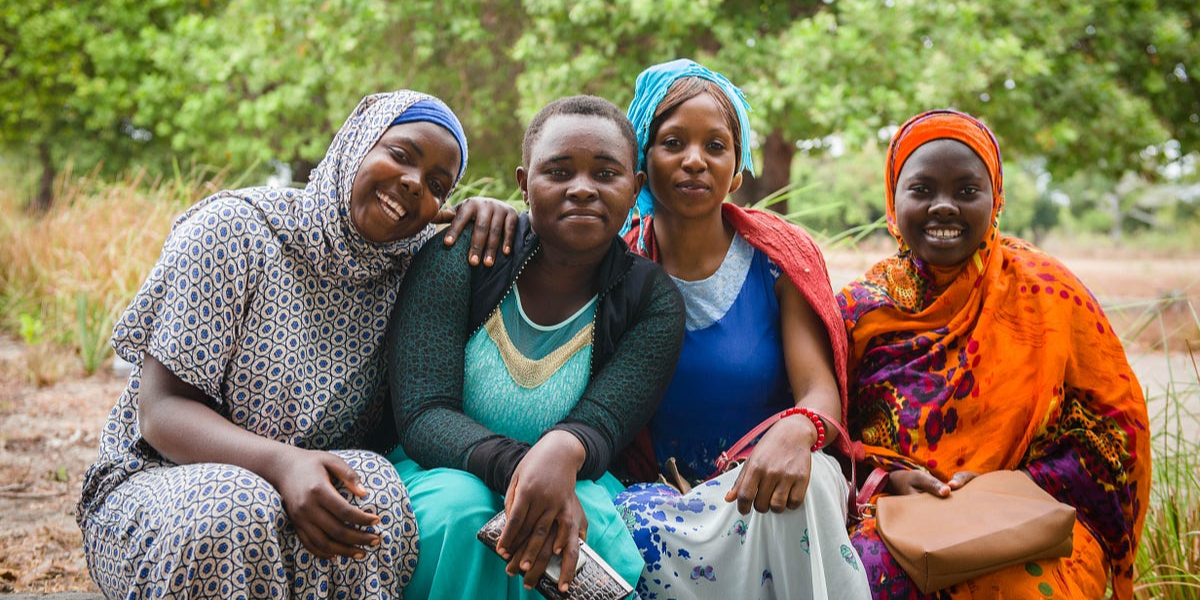
There are moments in life when a single decision splits your future into two paths — the one you were walking, and the one you could have walked. For many women in Southwest Cameroon, that moment came on the day they decided to learn.
This is not a blog post about statistics. This is not an analysis of literacy rates or development indicators. This is about five women who walked into Assertive Care Organization's adult education classrooms carrying decades of silence, doubt, and unfulfilled hunger — and who walked out carrying something else entirely.
These are their stories. Unpolished. Unfiltered. Unforgettable.
Grace: "I Wanted to Read My Daughter's School Report"
Grace is fifty-two years old. She has lived her entire life in a small village thirty minutes outside Buea. She married at sixteen, became a mother at seventeen, and spent the next three decades raising seven children while farming cassava and groundnuts on the small plot of land her husband inherited.
She never went to school. Not a single day.
When you ask her why not, she does not become defensive or bitter. She simply explains the facts as they were. Her father did not believe girls needed education. Her family needed her labor. There was no one to argue on her behalf, and so there was no argument. By the time anyone might have reconsidered, she was already a wife, already a mother, already locked into a life that left no room for classrooms.
For years, this did not feel like a crisis. Grace is intelligent and resourceful. She managed her household. She negotiated sales at the market. She raised her children without the ability to read their birth certificates or their school reports, and she did it with competence and pride.
But then her eldest daughter — the first in the family to finish secondary school — began bringing home report cards Grace could not read. Grace would hold the paper in her hands and feel its weight, feel the importance of what it said, and feel the helplessness of not knowing. She would ask her husband to read it to her. Sometimes he did. Sometimes he was too busy. Sometimes he did not understand what the grades meant either.
One day, her daughter asked her a simple question: "Mama, why don't you ever help me with my homework?"
Grace remembers the way shame settled into her chest in that moment. Not because her daughter was accusing her. Her daughter was not accusing anyone. She was just asking. But the question named something Grace had been carrying quietly for years — the sense that her inability to read was not just a personal limitation, but a gap in what she could give her children.
She enrolled in ACO's adult literacy program the following week. She was forty-nine years old.
Three Years Later
Grace graduated from the literacy program two years ago. Today, she not only reads her daughter's report cards — she helps her study for exams. She has joined the women's cooperative in her village and now serves as its secretary, keeping careful written records of savings and loans. She reads the Bible aloud in her church's women's fellowship group.
But the change she talks about most often is quieter than any of that. It is the way she feels when she signs her own name. The way she holds her head when she walks into a meeting where documents will be discussed. The way she has stopped apologizing for asking questions.
"I thought I was too old," she says. "But now I know — you are only too old if you decide you are."
Patience: "I Did Not Know My Own Age Until I Could Count"
Patience does not know the exact day she was born. Her parents did not keep written records. She grew up estimating her age based on the farming seasons and the major events she remembered from childhood. When she married, her husband guessed she was around twenty. When she gave birth to her first child, the nurse at the clinic made a guess and wrote it down. That number became official.
For most of her life, this vagueness did not matter much. But it mattered when she needed identification documents. It mattered when she tried to register for a government program and could not accurately fill out the date-of-birth field. It mattered when she wanted to apply for a small business loan and could not verify the most basic facts about herself.
More than the age, though, what troubled Patience was the numbers themselves. She could not count money reliably. She knew the difference between small and large amounts, but calculating change, adding up expenses, keeping track of earnings — these were skills she depended on others to perform for her. Usually her eldest son, who had finished primary school.
That dependence became a problem when her son left the village to look for work in Douala. Suddenly, Patience was alone with her small trading business — buying produce from local farmers and selling it at the market — and no one to help her with the math.
She enrolled in ACO's numeracy program not because she had big ambitions, but because she needed to survive without her son.
Two Years Later
Patience now runs her trading business independently. She calculates her expenses and profits in a small notebook she keeps in her bag. She knows, to the franc, how much she spends and how much she earns each week. She has started saving — something she never did before, because she could not keep track of what she had.
She also finally knows her age. During one of the program's financial literacy sessions, a facilitator helped her work backward from the major historical events she remembered — a particularly bad harvest year, the year the school in her village was built — and together they estimated her birth year with reasonable accuracy.
She is fifty-four. Give or take a year.
"It feels good to know," she says. "I am not just guessing anymore. About my age. About my money. About anything."
Beatrice: "My Husband Said I Was Wasting Time. Now He Asks Me to Read for Him."
Beatrice's husband was not supportive when she first told him she wanted to attend ACO's adult education classes. He thought it was a waste of time. What did she need to read for? She had managed fine for forty-three years without it. She had work to do. The house needed her. The farm needed her. Why would she spend her afternoons sitting in a classroom like a child?
Beatrice went anyway.
It was not easy. She had to wake up earlier to finish her chores before class. She had to bring her youngest child with her on days when no one else could watch him. She had to endure her husband's irritation and her neighbors' curiosity and her own internal voice that sometimes agreed with her husband — that maybe this was foolish, maybe she was too old, maybe it was too late.
But she did not stop.
The turning point came five months into the program. Beatrice's husband received a letter from a government agricultural office about a subsidy program for small-scale farmers. The letter was written in formal language, and he could not make sense of it. He asked his neighbor to read it. The neighbor was not sure either. He asked his brother. His brother was busy.
Finally, he brought the letter home and asked Beatrice.
She read it slowly. She stumbled over some of the formal terms, but she got the main idea. She explained the eligibility requirements to her husband. She helped him identify the documents he needed to apply. Together, they filled out the application — Beatrice writing in the answers her husband gave her.
He did not say much when they finished. But a week later, when she was leaving for her next class, he told her to go. He did not complain. He did not ask her to skip it. He just told her to go.
Eighteen Months Later
Beatrice completed the full adult education program. Her husband now openly supports her participation in the women's savings group she joined after graduation. When neighbors ask him about it, he tells them his wife can read and write better than most men in the village.
Beatrice has gone further than she initially imagined. She completed the entrepreneurship training module ACO offers as part of its women's empowerment track. She used what she learned to start a small soap-making business. She keeps her own records. She manages her own accounts. She is teaching two of her neighbors how to make soap, and she is writing down the instructions so they can follow them on their own.
She does not talk about her husband's initial resistance anymore. But when someone asks her what the program gave her, she does not talk about reading or writing first.
She talks about respect.
"People see me differently now," she says. "But the truth is, I see myself differently. That is what changed first."
Lydia: "I Never Knew What My Name Looked Like on Paper"
Lydia's story is different from the others in one important way — she came to the program with a specific, focused goal. She wanted to learn to write her name.
That was it. She was not interested in reading books. She was not planning to go into business. She did not have children whose homework she wanted to help with. She just wanted to be able to sign documents herself instead of using a thumbprint.
For her entire adult life, every official document Lydia touched required a thumbprint. Marriage certificate. Birth registrations for her children. Land agreements. Loan forms. Every time, she pressed her thumb into ink and left her mark — a mark that said, louder than any words could, that she could not write her own name.
It humiliated her in a way that never softened with repetition. Each thumbprint was a small surrender, a small admission that she was less than the person sitting across from her with a pen.
When ACO's community health worker came through her village promoting the new adult education cohort, Lydia asked only one question: "Will you teach me to write my name?"
The answer was yes.
Six Months Later
Lydia did not stop at her name.
Once she learned to write "Lydia Nkemnji," she wanted to know what the letters meant. She wanted to know how to write other words. She wanted to know how to read the words she was writing. Six months into the program, she could write full sentences. A year in, she was reading simple texts.
She still talks about the day she signed her name for the first time on an official document. It was a receipt at the market for a bulk purchase of palm oil. The seller handed her a pen automatically — not a thumbprint pad, a pen. He assumed she could write.
She could.
She wrote "Lydia Nkemnji" in careful, slightly uneven letters. She handed the receipt back. The seller did not react. It was not notable to him. To Lydia, it was everything.
"I never knew what my name looked like on paper," she says. "Now I see it everywhere I go, because I put it there myself."
Margaret: "I Learned to Read So I Could Teach My Granddaughter"
Margaret is sixty-one years old. She is a grandmother to nine children. She has buried a husband and raised her children alone. She has survived poverty, conflict, displacement, and grief that would have crushed someone less determined.
She enrolled in ACO's adult education program at fifty-nine — the oldest participant in her cohort by more than a decade.
When the facilitator asked her why she wanted to learn to read, Margaret's answer was immediate: "For my granddaughter."
Her granddaughter, Faith, is seven years old. She lives with Margaret because her mother — Margaret's daughter — is working in another region and cannot care for her full-time. Faith is in Primary 2. She loves school. She comes home every day with homework, and every day she asks her grandmother for help.
For two years, Margaret could not give it. She would sit with Faith and hold the book and pretend to understand what she was looking at, making up answers or telling Faith to ask her teacher the next day. Faith never complained. But Margaret knew. She knew her granddaughter was being patient with her, and the knowledge of it was unbearable.
So she learned.
Fifteen Months Later
Margaret still struggles with reading. She is slower than the younger women in her cohort. She needs more repetition. She forgets things she learned the week before. But she keeps showing up.
And now, when Faith brings home her homework, Margaret sits beside her and reads the questions aloud — slowly, sometimes needing Faith's help with a word, but reading. Together, they work through the assignments. Together, they sound out difficult words. Together, they celebrate when Faith gets a good grade.
Faith does not know that her grandmother learned to read just for her. Margaret has not told her. But one day, she will. One day, when Faith is older and can understand what it cost, Margaret will tell her that love looks like a sixty-one-year-old woman sitting in a classroom full of people half her age, learning to read so she can help a seven-year-old with her homework.
For now, they just sit together at the table every evening, books open, pencils in hand, learning side by side.
What These Stories Mean
Grace. Patience. Beatrice. Lydia. Margaret. Five women. Five different starting points. Five different reasons for walking through the door. But one shared truth — that it is never too late, that dignity is not a luxury, and that the decision to learn is the decision to reclaim a part of yourself that the world tried to take.
These women did not wait for perfect circumstances. They did not wait for encouragement from everyone around them. They did not wait until it felt easy or safe or convenient. They walked into ACO's classrooms carrying doubt, fear, shame, and hope all at once, and they chose hope.
What happened next was not magic. It was work. Hard, slow, unglamorous work. Showing up when they were tired. Practicing when their hands ached. Pushing through frustration when letters refused to cooperate and numbers refused to make sense. Returning week after week even when progress felt invisible.
But the work paid. Not just in skills acquired, though the skills matter. It paid in confidence rebuilt. In voices rediscovered. In futures reimagined. In children and grandchildren watching their mothers and grandmothers become students and deciding, somewhere deep in their young minds, that learning is a lifelong right, not a childhood privilege.
These women did not just learn to read and write. They taught their families, their neighbors, their communities what courage looks like.
The Stories We Do Not Hear Enough
In global conversations about literacy and education, we hear a lot about children. As we should. Early childhood education is critical. School enrollment matters. Keeping girls in school matters profoundly.
But we do not hear enough about women like Grace and Patience and Beatrice and Lydia and Margaret. We do not hear enough about the millions of women across Africa and the world who were not in classrooms as children and who still carry the weight of that absence every single day.
We do not hear enough about the extraordinary resilience it takes to learn as an adult — to sit in a room and be a beginner again, to struggle publicly with something others find simple, to fight the voice in your head that says you should have learned this decades ago and it is embarrassing to be learning it now.
We do not hear enough about the ripple effects when a mother becomes literate — the improved health outcomes for her children, the higher school attendance, the better household financial management, the stronger community participation. We do not hear enough about the way adult education does not just transform the woman sitting in the classroom — it transforms the entire ecosystem around her.
At Assertive Care Organization, we hear these stories every single day. We see the transformations up close. We watch women walk into our programs carrying decades of doubt and walk out carrying notebooks and pens and an unshakable conviction that they are capable of more than they were told.
And we believe these stories deserve to be heard. Not as footnotes to reports. Not as statistics in a database. But as the powerful, world-changing narratives they actually are.
The Empty Seat Waiting for Her Story
In every cohort ACO runs, there is a woman who almost enrolled but did not. She walked past the classroom. She heard about the program from a neighbor. She thought about it — maybe for weeks, maybe for months. She wanted to come. But something stopped her.
Maybe it was fear. Maybe it was shame. Maybe it was a husband who discouraged her or a schedule that felt too full or a voice in her head that whispered she was too old, too busy, too far behind to catch up.
She is still out there. In Buea. In the villages around it. Carrying the same hunger that brought Grace and Patience and Beatrice and Lydia and Margaret through the door. Waiting for one more reason to believe that it is not too late, that she is worth the investment, that learning is her right no matter how many years have passed since childhood.
To that woman, if she is reading this somehow, or if someone is reading it to her:
There is a seat waiting. There is a facilitator ready to meet you exactly where you are. There is a room full of women just like you — women who doubted and came anyway, women who were scared and showed up anyway, women who thought it was too late and learned that it never is.
Your story is not over. It is just beginning.
Assertive Care Organization's Adult Education and Women's Empowerment program runs year-round literacy, numeracy, financial literacy, and entrepreneurship training for women in Buea and surrounding communities in Southwest Cameroon. Enrollment is open. No one is too old. No one is too far behind. Everyone is welcome.
To learn more, to support the program, or to refer someone who might benefit, connect with ACO in Buea.

Leave a comment
Your email address will not be published. Required fields are marked *